
Why does staff resist health programmes
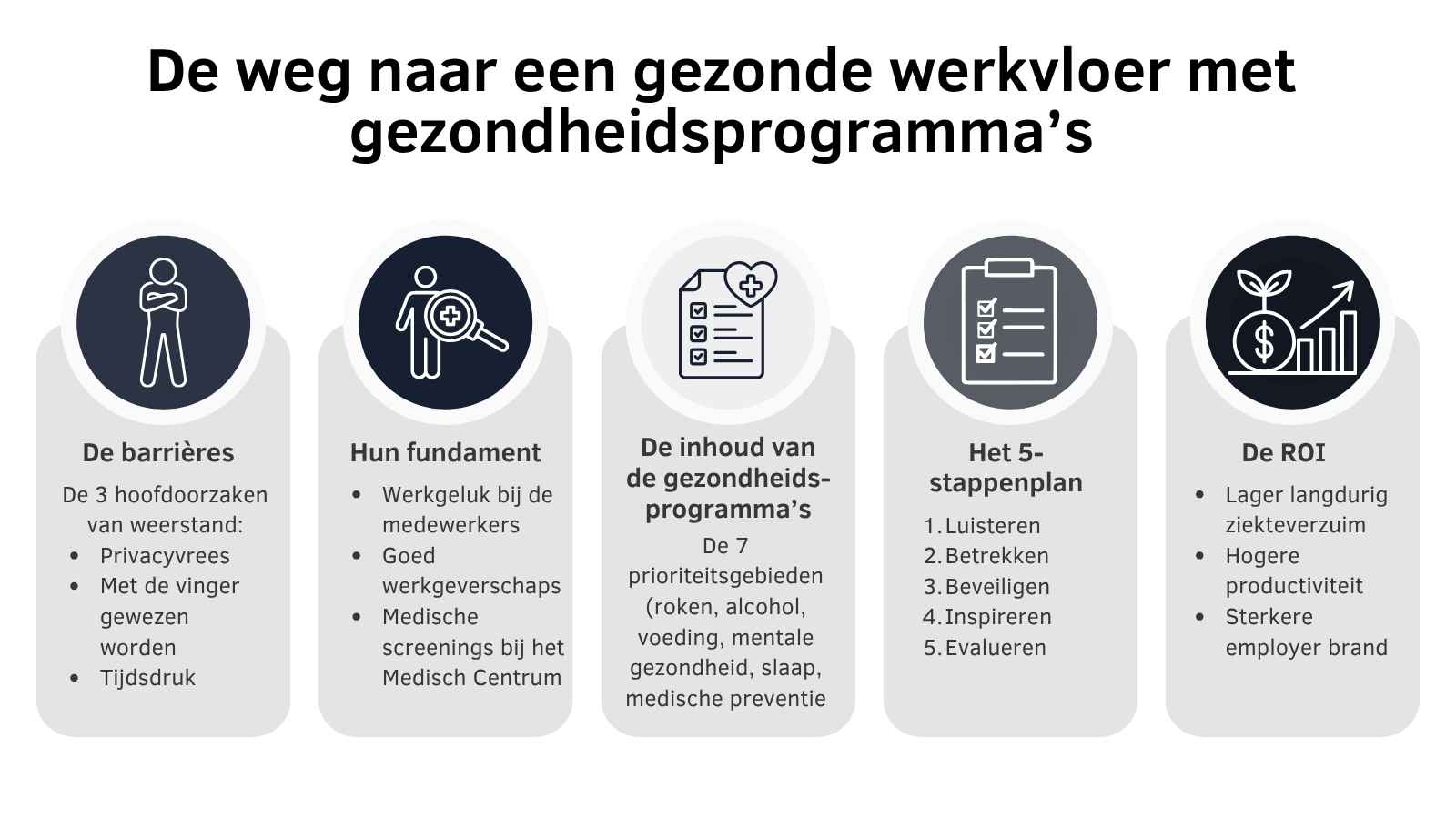
Before you a health programme launches, it is important to understand where things are just going wrong with your staff. The most common reasons for resistance from your employees are:
In short, the resistance your staff offers to health programmes is rarely a sign of unwillingness, but rather a natural reaction to the lack of direction and safety in the workplace. When health feels like an obligation from above, the barrier to effective participation becomes even higher for employees. Therefore, the key to success often lies not in forcing employees to actively participate, but rather in understanding the underlying drivers of your team. To break down these barriers, you need to shift the focus from just the medical aspect to the broad framework of job happiness.
The psychology behind your staff's resistance: The role of work happiness
To bend your staff's resistance to engagement, you need to look at the psychology of the workplace. That is why a health programme never separate from the eight factors of job happiness. When these factors are balanced in the workplace, your employees experience the space to start working on their vitality.
The eight factors of job happiness:
- Autonomy: The freedom to make your own choices within the programme.
- Growth: The chance to learn new skills such as stress management.
- Significance: Understanding why their health contributes not only to the company, but more importantly to their personal goals.
- Satisfaction: Feeling successful at achieving a health milestone.
- Social support: A culture where colleagues motivate rather than criticise each other.
- Rating: The employer's recognition of the employee's commitment.
- Fun: A playful approach lowers the threshold for their participation in the health programme.
- Security: The absolute certainty that health data remains solely private.
The 6 principles of being a good employer
Most employers and HR departments think it helps to force their staff to participate in the health programme, but this obviously just backfires. Because, when you force your staff, you take away their autonomy and that is precisely what creates their resistance. Do you really want to motivate your employees? Then first use the six principles of being a good employer as a compass for your health policy.
- Caring: Take time to the health programme prepare and base decisions on facts and not assumptions.
- Ban on arbitrariness: Make sure the offer is accessible and above all fair to everyone, regardless of their position or department.
- Clarity: Be clear about what happens to medical results and who has access to them.
- Reason: Explain not only what you do, but more importantly why you as an employer think this is important for their well-being.
- Fair Play: Give employees a chance to have their voices heard and involve them in shaping the health programme.
- Proportionality: Make sure the programme load, such as the time investment, is commensurate with the purpose that you want to achieve with it.
The 7 priority areas for health promotion
To make your health programme strong in content, you can use the seven pillars of occupational health. By choosing from these what is relevant to your team, you increase the motivation to participate.
- Smoking: Offering support to quit smoking, without judgement.
- Alcohol: Raising awareness about the impact of alcohol consumption on their energy and sleep.
- Nutrition: Provide access to healthy choices and education on stable energy levels.
- Motion: Encourage exercise both during and outside working hours.
- Mental health: Focus on stress management and preventing burnout.
- Sleep and energy: Attention to recuperation, crucial for shift workers or high-stress jobs.
- Medical prevention: Early detection of risks through professional medical screenings.
Your strategy for warming up and motivating your staff for the health programmes
So how do you translate this theory into practice? A successful strategy rests on these three pillars:
- Participation: Let employees choose from the different themes of the seven health promotion priority areas that they consider important.
- Transparency: Communicate repeatedly that participation is voluntary and that the employer does not have access to individual health results.
- Leadership: If management itself first participates in a medical check-up, this sends a powerful signal to employees in terms of shared values.
Roadmap: From announcement to a supported health programme
Therefore, to effectively minimise resistance among your staff and maximise the participation rate, it is best to follow these five steps:
- The listening phase: You will collect input. Launch the health programme so not just out of the blue. Start with short, anonymous surveys. Ask your employees in which of the seven priority areas they need support. As a result, employees will feel heard.
- Form a 'Health Council': Assemble a diverse group of employees to act as ambassadors. They will help think through practical details, such as the timing of the screenings and mode of communication. Resulting in the presence of social support and connectedness in the workplace.
- Security-first communication: Take a positive approach. Communicate explicitly about safeguarding their privacy. The medical screenings are carried out by our doctors. As an employer, you don't receive individual results, only an overall group report in order to improve welfare policy. As a result, you remove the main barrier of privacy fears.
- The kick-off as an example: Organise an official launch event. Let management be the first to schedule their appointments for a check-up at the Medical Centre. This shows that health is a shared value within the organisation, regardless of hierarchy. Resulting in credibility and fair play in the workplace.
- Feedback and continuity: A one-off action often arouses cynicism. Make health a regular agenda item. Share overall successes and ask after the first screenings What can be done better. The result is sustainable job happiness and a culture of continuous growth.
The foundation: medical screening as an objective starting point
A quality health programme does not start with a one-off action, but with an objective medical baseline measurement. The preventive medical screenings are the foundation. At the Medical Centre, we therefore offer in-depth check-ups to those that go beyond standard controls. Think of cardiac evaluations, neurological screenings and metabolic analyses. This provides the employee with a unique personal health compass. Because these results remain 100% private between the doctor and the employee, the screening acts as an ultimate token of appreciation from the employer.
What's in it for you? Strategic ROI for the employer
A health programme without resistance is not charity, it is a strategic investment with a measurable return. When you choose an approach in partnership with Medical Centre, it translates into the following benefits for your organisation:
A health programme without resistance requires a shift from control to trust between the employer and employee. By focusing on job happiness and high-quality medical support create a culture where vitality becomes a joint success. Want to take your organisation's health to the next level? Plan now your no-obligation consultation in at the Medical Centre.
Health is the greatest asset. Preventive screening is the first step to maintaining it.
At the Medical Centre, care, trust and expertise go hand in hand. We offer quality medical screenings in a casual atmosphere.