
Medical screening and the law: What are employers allowed and not allowed to do?
When people talk about a medical screening for employees, we note that, in practice, there is still a great deal of confusion surrounding the legislation. What is actually required by law, what is prohibited, and what can you, as an employer, offer on your own initiative? To avoid unpleasant legal surprises, it is crucial to Belgian labour law easy to understand.
What exactly does a medical check-up involve?
If you decide to undergo a preventive health check-up, it is worth noting that professional medical screening with a reputable provider is never just a single test. It is a comprehensive health programme that is always carried out seamlessly and expertly consultations combines with the corresponding investigations or screening.
This medical process therefore follows a very logical structure. Regardless of the package chosen or your employee’s risk profile, all medical screenings begin with an in-depth clinical research. During this examination, the doctor lays the groundwork for the rest of the medical check-up. Therefore, there is always an in-depth discussion first, during which the employees’ lifestyle, medical history and any symptoms they may have are discussed. This discussion is also combined with basic physical measurements, such as checking blood pressure, reflexes and BMI.
Only once a fundamentally clear clinical picture has been established do the specifically selected investigations. Depending on your staff’s needs, a medical check-up consists of specific, targeted screening.
- Blood and urine tests: An in-depth laboratory analysis to monitor vital parameters such as cholesterol, blood sugar levels, and kidney and liver function.
- Cardiology screenings: As a resting electrocardiogram (ECG) to measure the heart’s electrical activity. Or a cycling test to assess cardiac function during physical exertion.
- Medical imaging and organ tests: Just think of an abdominal ultrasound scan to examine the organs in the abdominal cavity, such as the liver and kidneys. Or a duplex scan of the carotid arteries to monitor blood flow to the brain.
- Functional testing: As a spirometry test or targeted eye and ear tests.
Would you like to know exactly what this kind of medical screening involves for your team, and which B2B packages are best suited to your sector? Then be sure to take a look at our various care packages and read the in-depth blog post about what a medical screening for your staff actually involves.
Is a health check-up compulsory at work?
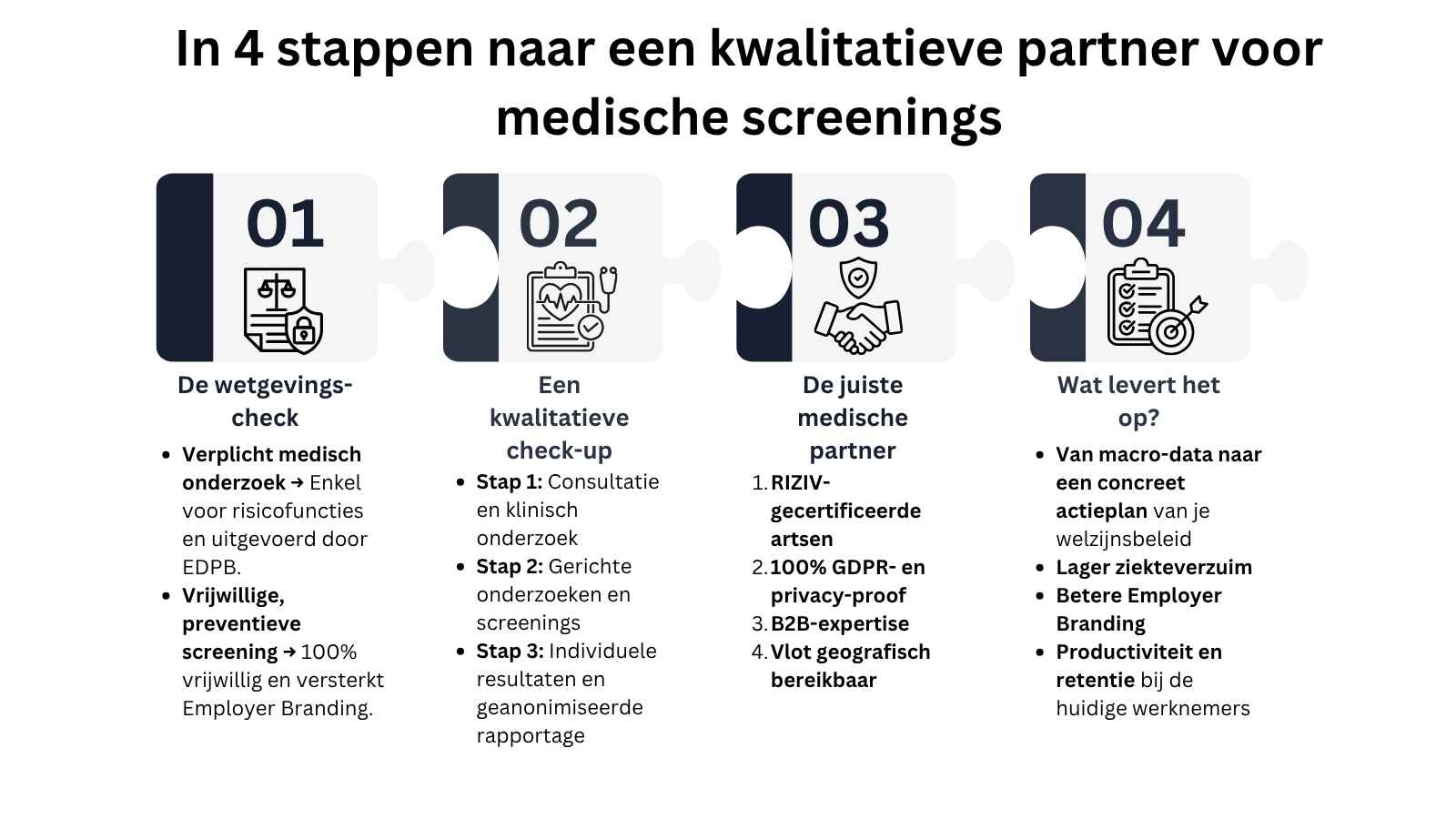
In Belgium, medical supervision in the workplace is strictly regulated through The Codex on well-being at work. The law requires you, as an employer, to arrange for certain categories of staff to undergo periodic medical examinations. However, this only applies to staff who carry out high-risk roles.
- Safety features: Employees who operate machinery, drive forklift trucks or drive vehicles where the safety of others is at risk.
- Roles involving a specific risk: Employees who are exposed to chemical, biological or physical agents such as extreme levels of radiation or toxic substances.
- Positions involving increased workload: Just think of night work, demanding shift patterns or jobs that place a high ergonomic strain on the body.
These statutory health checks form part of the formal medical supervision and are carried out exclusively by the doctors at the External Service for Prevention and Protection at Work (EDPB).
We are often asked: Can an employee refuse to undergo this medical examination whilst at work? The answer is no. If it concerns a legally required check for a certified high-risk role, the employee is legally obliged to take part. If an employee refuses to do so, you, as the employer, may no longer allow that person to carry out their duties, as otherwise you, as the employer, will be in breach of welfare legislation.
So what about the voluntary health checks at the Medical Centre?
As well as staff in high-risk roles, there is also a wider team of staff, such as your office staff, administrative staff or management. You may also wish to offer them a medical check-up as an additional benefit. The rule here is that these are voluntary, preventative screenings designed to promote the general well-being and health of staff.
This group therefore always has the right to refuse to take part. As an employer, you must not exert any pressure or impose sanctions in the event of a refusal to take part in the preventive screening. A reputable partner, with whom you carry out the voluntary preventive screenings, will communicate this clearly. By making it clear in advance that the screenings are purely intended to help them and that the employer itself will not have access to individual data, employees will understand that this is about their wellbeing. This lowers the barrier to participation and maximises willingness to participate on a voluntary basis.
What are the rules regarding job applications and monitoring?
Another frequently asked question in the HR department is: “What are the rules regarding medical examinations for job applicants?”
Since the introduction of strict legislation concerning the protection of privacy and Collective Labour Agreement No. 38, a general or systematic medical examination at the time of recruitment is strictly prohibited. You may only require a job applicant to undergo a medical screening if the specific, vacant post has unique and, above all, objective medical requirements that are necessary to carry out the job safely. Examples include an airline pilot or a firefighter. A medical screening must never be misused to screen out healthy and unhealthy candidates in advance or to exclude people with chronic illnesses.
In addition, as part of a preventive health policy often accompanied by the concern: “Is it permissible to monitor employees?”
The answer is clearly no. You must never monitor, track or access your employees’ individual health data. The GDPR legislation and medical confidentiality is strictly observed in this regard. An external medical partner may not, and will never, disclose medical records, blood test results or specific diagnoses to the employer or the HR department. A medical screening is a tool for prevention and support for the individual, but never a monitoring tool for compiling records or assessing performance.
As an employer, you do play a crucial role in society. Would you like to know exactly how things stand from a legal and ethical perspective? And how to strike the perfect balance between legislation and your duty of care? Then read our in-depth blog on Medical screening as a legal and moral duty of the employer.
Why is a medical screening beneficial for your company?
Now that the legal boundaries are clear, the question naturally arises: “Why would an organisation invest in a comprehensive, preventive health screening if this is not a legal requirement for all its employees?” The answer is simple. It makes for a strong business case. A preventive medical check-up is not cost, but a strategic investment in your human capital. When you take a proactive approach to your team’s health, you, as an employer, will reap the benefits.
1. A drastic reduction in sick leave
Many serious lifestyle-related illnesses, such as chronically high blood pressure, pre-diabetes, cardiovascular risks or symptoms of burnout, develop silently. Employees often live with these conditions for years without realising it, until the illness actually strikes and they are off work for months.
Through proactive screening, these risk factors are identified at a stage of development when they can still be easily and quickly addressed through targeted lifestyle, dietary or stress management changes. Given that a day sick leave As it costs a company hundreds of euros on average – just think of guaranteed pay, temporary staff costs and lost productivity – every day of sickness that is prevented immediately pays for the investment in medical screening.
2. A powerful asset in employer branding
In today’s job market, many companies are looking for the same talent. Employee benefits therefore really do make the difference. By offering a high-quality medical check-up, you position yourself as a modern and caring employer who genuinely invests in the wellbeing of their staff. This not only helps you to talents to attract customers, but it also boosts loyalty and retention of your current staff. People tend to stay with an organisation for longer if they feel genuinely valued.
3. Increased productivity, focus and energy
Employees who feel physically and mentally fit perform better. They are more focused, make fewer mistakes, are more creative when it comes to problem-solving, and are better able to cope with periods of healthy work pressure. A medical screening gives your employees a personal energy boost. They are provided with practical insights and tips to improve their own vitality, which has an immediate effect on their productivity in the workplace.
4. Immediate reduction in presenteeism costs
Presenteeism is at least as dangerous as absenteeism. This means that, whilst employees are physically present at work, they are only working at 50% of their capacity due to physical ailments, poor sleep or mental fatigue. This costs organisations a great deal of money without them realising it. A preventive medical examination ensures that these symptoms are documented and helps employees regain their full potential.
5. From reacting to minor issues to a proactive wellbeing policy
Many HR departments spend their budget on ad hoc wellbeing initiatives such as a weekly fruit basket, a one-off workshop on ergonomics or a subscription following a case of burnout. Although these initiatives are well-intentioned, they often amount to spending money without knowing whether they are having any effect.
Medical screenings fundamentally change your HR policy. The anonymised group reports provide you with hard, medically validated data on the actual needs of your specific workforce. This puts an end to guesswork and enables you to allocate your wellbeing budgets in a targeted manner, with measurable results.
Where does a medical screening take place, and who carries it out?
Organising a medical check-up It must not disrupt your business’s operational flow. That is why flexibility is crucial. Depending on your logistical preferences and the size of your business, screening can be carried out in two ways.
- In-company, at the client’s own premises: We’ll send a medical team to your workplace. Staff will pop in briefly during their working hours for their check-up and can get straight back to work afterwards. This minimises loss of productivity and makes it easier for staff to take part.
- At an external medical centre: Your staff can also book individual appointments on-site. They will then be welcomed at our professionally equipped centre. This is ideal for smaller teams, spread-out locations or for senior staff who require absolute discretion outside the company premises.
Who carries out the research?
Carrying out the screenings, interpreting complex blood test results and conducting preventive health consultations is not the role of lifestyle coaches or online tests. This requires certified, independent doctors and medical professionals. To guarantee clinical validity, reliability and quality standards, it is essential to collaborate with a specialised, independent medical centre that thoroughly understands the B2B market, such as the Medical Centre.
So how do you find the right partner – and, above all, one who’s high-quality?
The range of health checks and health weeks on offer has exploded in recent years. For an HR department or occupational health adviser, it is a challenge to select the right – and, above all, high-quality – partner from the market. What criteria must a high-quality partner for medical screenings actually meet? When making your selection, bear in mind four critical criteria.
- Medical expertise and scientific evidence: The medical screening should not be a superficial ‘feel-good’ check-up. Ask whether the partner works exclusively with BIG- or Registered with the RIZIV doctors and nurses. Furthermore, the protocols must be based on scientifically proven medical guidelines, so that the results are clinically valid.
- Rock-solid privacy and GDPR compliance: This is the absolute breaking point. A high-quality partner acts as an independent, external buffer between you, as the employer, and your employees. Medical confidentiality is sacrosanct. This means that individual medical reports must never be shared with the HR department, senior management or the health and safety adviser. The results are sent directly and exclusively to the employee themselves.
- Experience in the business-to-business (B2B) market: The medical world often speaks a different language to the business world. A high-quality medical partner understands the workings of a business. They work with you to devise flexible schedules and take the pressure completely off your HR team when it comes to organising and communicating internally about medical screening.
- Geographical accessibility: For businesses located in Flanders’ economic hubs, having a medical partner with an easily accessible base is a huge advantage. A strategically located preventive healthcare centre in Antwerp ensures that your staff and senior management who require comprehensive or personalised care can easily reach the centre, situated close to the major access roads.
Why choose the Medical Centre?
When you enter the medical centres market, you will find that many providers focus solely on superficial ‘feel-good’ check-ups or general health weeks. That is why it is essential to specifically choose a partner such as the Occupational Health Centre.
Why does the Medical Centre make a difference to your organisation?
- Certified doctors only: Every examination, every blood test and every functional test is carried out and assessed by RIZIV-registered doctors and highly qualified medical professionals. This ensures that the results are medically valid and, where necessary, can be used immediately by the employee’s GP.
- Complete independence: As an external medical centre, we act as a neutral, reliable buffer between you, as an employer, and your staff. This is the only way to safeguard medical confidentiality and create a safe environment in which employees feel comfortable talking openly about their health.
- Specialisation in the business market (B2B): We understand that your operational workflow must not be disrupted. Our medical teams are trained to carry out medical screening efficiently, in a well-organised manner and with minimal impact on your work schedule.
- Advanced infrastructure: Unlike many organisations that use mobile sensors, here at the Medical Centre we have the high-quality equipment required for a truly in-depth examination, ranging from resting ECGs up to comprehensive laboratory analyses.
By choosing the Medical Centre, you are not simply opting for a one-off medical test for your employees, but for a medically underpinned quality standard that provides your HR policy and your staff with the protection and insights they deserve.
What specific benefits does this high-quality partner bring to your business?
The fundamental difference between a standard medical test and a genuine strategic partner lies in what happens after the test has been carried out the screenings and the studies. A high-quality partner won’t just provide you with a pile of isolated test results, but will translate the collected data into directly applicable business insights for your HR and welfare policy. So, when you choose a high-quality medical partner, this brings your organisation a number of concrete and tangible benefits.
1. Your organisation’s medical dashboard
Once your team’s individual medical screenings have been completed, a reputable partner will compile the results into an anonymised group report. However, this is only on condition that the population tested is large enough to safeguard your team’s medical confidentiality and individual privacy. This report is worth its weight in gold for your HR department or health and safety adviser. It provides you with an objective snapshot of the health, vitality and risk factors within your corporate culture. You no longer need to rely on gut feeling or casual conversations. You will then have solid, medically substantiated insights.
2. From data to a targeted, cost-effective action plan
Thanks to the detailed group reporting, the guesswork is over and you can take highly targeted action. The data shows you exactly where the priorities lie, enabling you to allocate your wellbeing budgets efficiently. Instead of rolling out general initiatives, you can tailor your actions perfectly to the actual needs of your employees.
From anonymous macro-data to direct action
- 35% of your population is at increased cardiovascular risk and has high cholesterol: You will introduce targeted workshops on healthy eating in the staff canteen and launch a regular exercise scheme in the workplace.
- Within a specific department, there is a strikingly high score for physical symptoms: You have these specific workstations assessed by an ergonomist and make targeted investments in dynamic furniture.
- The indicators for chronic stress, reduced resilience and sleep problems are above average: You are rolling out a specific resilience and stress management programme to proactively prevent burnout.
3. Clear, black-and-white evidence of your welfare ROI
Within many organisations, it is a challenge for HR to secure funding for health initiatives, as the return on investment is often seen as intangible. A high-quality partner will help you to Return on Investment to improve it – drastically, in fact. Thanks to the anonymous baseline survey by the initial medical screening After repeating this, say, a year later, you can demonstrate to the management in black and white that the targeted interventions have led to improved health indicators and a demonstrable reduction in sick leave.
4. Maximising participation by taking the hassle out of it
A high-quality partner also saves your organisation a huge amount of time. Launching an in-house health screening programme involves a great deal of logistics and communication. An experienced medical partner takes care of all this for you. From drafting clear, reassuring internal communications to providing a seamless digital booking platform for appointments. This professional and accessible approach directly translates into maximum, voluntary participation within your teams.
Conclusion: Choose a partner who takes the pressure off and offers advice
A high-quality partner for medical screenings does much more than simply check your employees’ physical health. They navigate the delicate balance between medical expertise, strict Belgian privacy legislation and your commercial HR objectives. By choosing a partner who speaks your language and translates the data into a concrete action plan, you lay the foundations for a healthy, resilient and future-proof organisation. Are you curious to find out how we work at the Medical Centre medical screenings Are you looking to organise 100% initiatives that comply with the law and really deliver results for your business? Then let’s work together to take your business to the next level. Take action today contact Contact us for a consultation or a proposal tailored to your organisation. Or discover and book choose one of our specific B2B packages.
Health is the greatest asset. Preventive screening is the first step to maintaining it.
At the Medical Centre, care, trust and expertise go hand in hand. We offer quality medical screenings in a casual atmosphere.