
What exactly does preventive medical screening entail?
Before we zoom in on the practice, it is essential to clear up a major misunderstanding. A preventive medical screening is not the same as the compulsory medical examination of an external prevention service or a check-up visit in case of sick leave. This is a high-quality, proactive and completely voluntary health check that you offer to your team as an extralegal benefit.
To meet the specific needs of your organisation and especially employees, we work with different, evidence-based B2B packages and customised care formulas. Depending on the age, risk profiles and sectoral load of your employees, there are three targeted formulas to choose from.
- Cardio Check: A targeted basic screening of about 2.5 hours with a focus on the heart and lungs. This package is ideal for young adults who want to monitor their cardiovascular health preventively.
- Health Check: A broader screening of about 3.5 hours for those who want a complete look at overall health. This package complements the Cardio Check by including an ultrasound scan of the abdominal organs and an intestinal examination. Recommended for adults aged 35 and over.
- Vital Check: Our most comprehensive, multidisciplinary health screening of about 6 hours. This package is recommended for employees over 40 years old. The content is fully tailored to your employees' medical history and individual risk profile.
Our specific screenings
Depending on your employees and the chosen B2B package, we put together a targeted medical screening. Our offer of screening is comprehensive and combines both approachable basic tests and in-depth diagnoses.
- General clinical research: A basic physical screening by the doctor.
- Biometrics and fat percentage: Accurately scanning fat percentage, BMI and weight.
- Comprehensive blood and urine tests: Detecting hidden risks such as diabetes, cholesterol problems or kidney deficiencies.
- Basic cardiovascular tests: An electrocardiogram (ECG) and if appropriate an effort test (cycling test) or echocardiography.
- Targeted ultrasounds: An ultrasound abdomen and a duplex scan of the cervical vessels To detect arteriosclerosis.
- Lung and respiratory examination: A spirometry and comprehensive pulmonary function tests.
- Sensory tests: Eye tests, ear tests and advanced audiometry.
- Preventive scans: Dermatoscan, bone densitometry and an EEG.
- Specialised keyhole surgery: Preventive colonoscopy and gastroscopy.
- Specific checks: Mammography and ultrasound for the women. Uroflow for the men.
A wide range of medical expertise
What makes the Medical Centre unique is that we do not stop at a general basic check. Behind our medical screening stands an extensive team of specialists and targeted investigations. Depending on the results or the specific risk profiles within your company, the following medical assessments can be deployed immediately.
- Cardiology: A thorough evaluation of the heart and blood pressure to detect cardiovascular risks early.
- Pneumology: Examination of lung function and breathing capacity, which is essential for overall vitality.
- Vascular medicine: Preventive control of blood vessels and general circulation.
- Neurology: Screening the nervous system and brain, which is closely related to your employees' focus and stress-related complaints.
- Gastroenterology: Targeted preventive examination of the stomach, intestines and digestive system.
- Urology and gynaecology: Age- and gender-specific screenings for targeted follow-up.
- NKO: Accurate monitoring of hearing and upper airways.
- Ophthalmology: Comprehensive vision tests, which is particularly valuable for employees who work on a screen for hours every day.
- Radiology and ultrasound: Medical imaging to accurately identify any underlying physical problems.
Why should you invest in medical screening for your business?
Offering a medical screening is not just a cost, but it is a strategic investment with a demonstrable Return On Investment (ROI). When you proactively focus on the health of your employees, this translates directly into measurable business benefits financially, operationally and strategically.
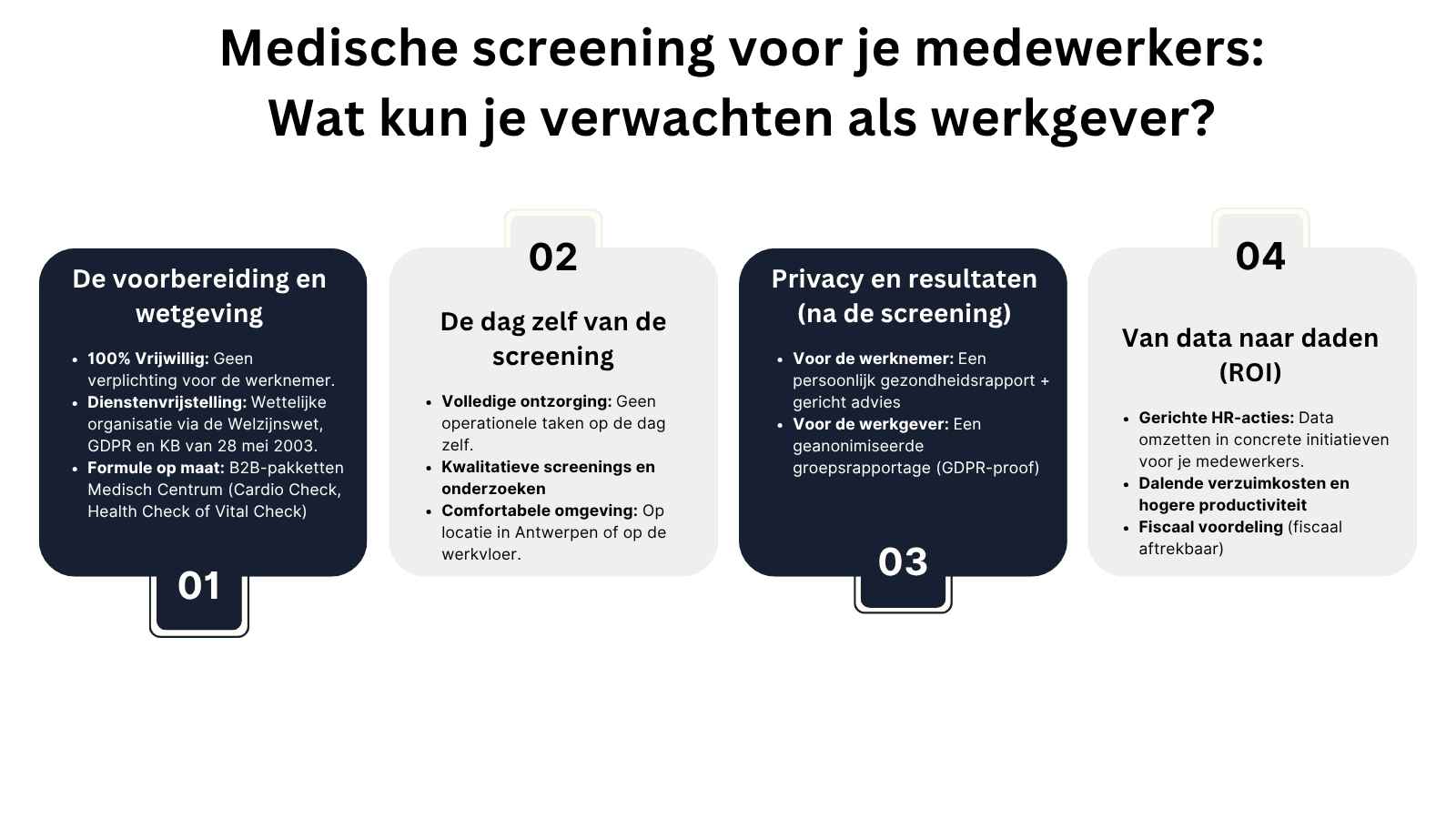
The gist: What can you expect before, during and after screening as an employer?
To make you as an employer as unburdened as possible, we have made the process of our medical screening designed in three clear stages. This way, you know exactly where you stand and when what needs to be done.
1. Before screening: preparation and legislation
In the run-up to the medical screening, your main role as an employer is to set the logistical lines in consultation with our team of specialists. You determine which groups of employees are eligible and schedule the dates.
Because medical screening touches on the privacy and physical integrity of your employees, this phase is legal considering the most important. In Belgium, the legislation on this is strict. When you offer preventive screening, you have to deal with a specific legal framework.
- The Belgian Welfare Act (Act of 4 August 1996): According to the law on the welfare of employees in the performance of their work, as an employer you are obliged to have a prevention policy. Voluntary medical screening through the Medical Centre is a perfect fulfilment of the fifth pillar of the Welfare Act, namely the protection of the worker's health. It falls under collective health promotion.
- The crucial distinction with legislation around Occupational Medicine (RD of 28 May 2003): You have to keep the legislation around compulsory medical certificates separate from this health initiative. The law mandates medical examination through an external prevention service only for workers in high-risk positions. The Medical Centre's preventive check-up does not fall under this obligation. It is a proactive, extralegal welfare benefit open to all employees.
- The General Data Protection Regulation (GDPR) and health data: Health data falls under the 'special categories of personal data' and enjoys strict legal protection. As an employer, you are not allowed to process, retrieve or store this data. The Medical Centre acts as an independent, external medical authority in this respect. We guarantee that individual data are protected.
2. During screening: what happens on the day?
On the day of the medical screening, you as the employer or HR manager have no operational task. Your employees are expected in our professional facility or, if agreed for larger groups, in our mobile medical units at your company site.
3. After screening: reporting and advice
As soon as the screenings and investigations are completed, the most important phase for you as an employer follows, namely feedback.
- For the employee: They receive a comprehensive, personal and clear health report. During a final discussion with the doctor, they receive concrete advice on diet, exercise and lifestyle. If acute risks are detected, they are immediately referred to their GP or a follow-up interview is scheduled.
- For the employer: While you won't get to see the individual records, you will receive a valuable, anonymised group report. This dashboard gives you a unique perspective on the overall health trends within your organisation.
4. From data to action: As an employer, what do you do with these insights?
The group report is not a document to be put confidentially in a drawer, it is the perfect blueprint for your future HR and well-being policy. Based on the anonymised health trends, you can take very targeted and effective action as an employer.
- Establish targeted HR initiatives: Does the group report show that a strikingly high percentage of your employees is struggling with high blood pressure, incipient diabetes or elevated cholesterol? Then you could, for instance, adjust your company catering, introduce healthy snacks or organise a workshop on healthy eating in the workplace.
- Implementing ergonomic improvements: Does the report identify many musculoskeletal complaints? Then this is the ideal time to invest in ergonomic office chairs, sit-stand desks or invite an expert to come and adjust your team's working posture.
- Commit to mental resilience: Do the data show worrying trends in terms of sleep deprivation or stress indicators? Then you can start intervening proactively with burnout prevention, low-threshold psychological support or organising training courses on time management and deconnection.
- Evaluate and adjust: By repeating this medical screening periodically, you can measure in black and white whether your wellbeing investments have had an effect. Do you see your company's overall health score rising? Then you know your HR strategy is paying off and you have instant figures to present to the board.
How do you successfully introduce medical screening to your employees?
The key to a successful health programme lies in internal communication. If employees feel that medical screening is a control tool, they will drop out. In contrast, frame it as a genuine health gift for their personal well-being and emphasise absolute privacy, and you will create enthusiasm. Want to know step by step how to apply this internally? Then read here our blog for successfully introducing a healthiness programme in the workplace.
Together we build a healthy business future
So as an employer, what can you expect from a medical screening? A flawless, professional process that completely unburdens your organisation, respects the privacy of your team 100% and provides you with the necessary insights to shape your wellbeing policy in a targeted way. It is the ultimate win-win for the modern, sustainable business. Want to take your organisation's vitality to the next level? Then discover our specific B2B packages. Take today contact with our experts for a consultation or an appointment tailored to your organisation.
Health is the greatest asset. Preventive screening is the first step to maintaining it.
At the Medical Centre, care, trust and expertise go hand in hand. We offer quality medical screenings in a casual atmosphere.