
The legal framework: What does the law say about medical screenings in the workplace?
In Belgium, occupational health legislation is strictly defined. The strict rules are therefore written down in black and white in The Codex on well-being at work, the Labour Code and specific Collective agreements. Many employers therefore wonder whether they can require medical screening. Whether this can be done depends on the nature of the job. But for the majority of employees, a medical screening is not mandatory. Nevertheless, there are legal obligations for the employer in terms of medical screenings.
When is medical screening mandatory?
In Belgium, the general rule is that an employee is not routinely subjected to a medical examination unless there is a specific need. The Codex on well-being at work provides that the employer is obliged to draw up a list of workers employed at a risk post.
According to the legislation, a medical screening mandatory for:
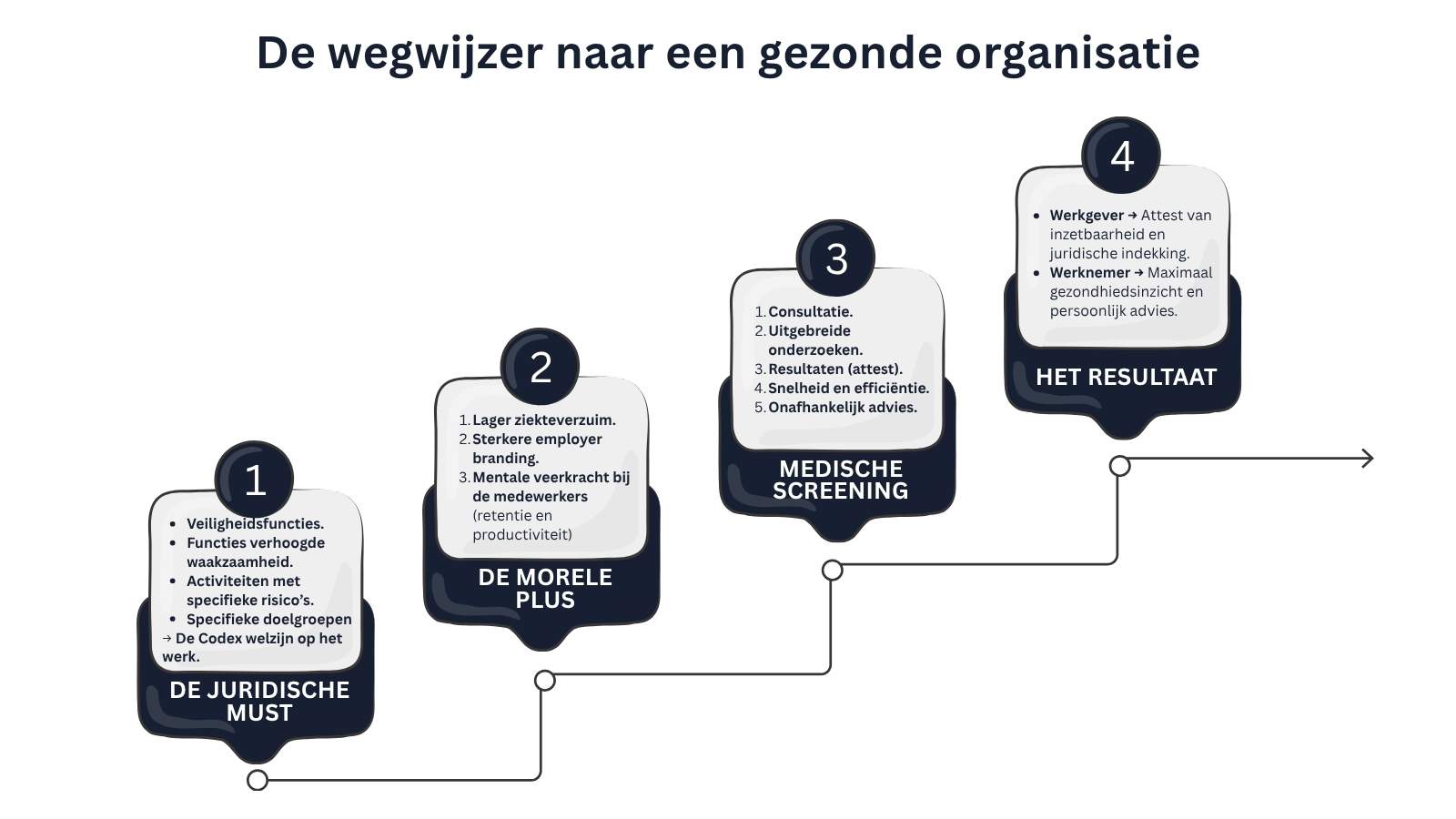
- Safety features: Functions where the use of work equipment or the operation of vehicles or cranes may endanger the safety of other workers.
- Functions with increased vigilance: These are functions such as monitoring chemical plants.
- Activities with specific risks: Exposure to chemical (lead, benzene), physical (noise, radiation) or biological aspects. It also includes heavy ergonomic strain such as manual lifting of heavy loads.
- Specific target groups: Trainees, student jobs and employees who are pregnant or breastfeeding.
The medical examination on recruitment
As an employer, you cannot start medically screening every job applicant. The CLA no.38 and the Law of 28 January 2003 state that medical screenings be allowed at recruitment only to test suitability for the specific job.
- Prohibition on prognostication: Medical tests designed solely to predict future illness or loss of productivity are prohibited.
- The results: The employment doctor only communicates the conclusion 'suitable' or 'unsuitable' to the employer of the potential new employee. Medical details remain known only to the doctor and the patient.
Employer's responsibility
The employer has a performance obligation regarding employee safety. When an employer fails to send an employee in a high-risk position for medical examination, as prescribed by the annual periodic health assessment, this can be seen as a serious fault in an accident.
This could then lead to criminal charges based on the Social Penal Code and full liability for damage claims not covered by work accident insurance.
Voluntary screening: The employee's right
Not every screening is an obligation from the employer. The law also gives employees rights:
- Spontaneous consultation: Every employee has the right to consult the prevention advisor-occupational doctor in case of health complaints due to work.
- Visit prior to work resumption: After a long period of illness (at least four weeks), an employee can request a medical examination himself to see if adjustments to the workstation are needed.
Employer responsibility: more than a checkbox
As an employer, you bear considerable responsibility. The question often asked regarding the employer's responsibility over your employee's health is one we can answer at the Medical Centre. The employer is indeed responsible for the health of employees.As an employer, you are legally obliged to identify and mitigate risks in the workplace. If you neglect this responsibility, you risk making a legally serious mistake. This happens, for instance, when an employer forces an employee to perform tasks for which he or she has been declared medically unfit. Or when necessary preventive health measures are structurally ignored. The consequences of such a grave error range from civil liability to serious damage to your organisation's image.
Moral responsibility: The human face of your business
Although the legal framework provides the basis for medical screenings, the most successful organisations go a step further. Here, the focus shifts from having to to wanting to. An employer's moral responsibility manifests itself in proactively offering medical screenings, even when this is due to the law is not strictly enforced.
Why do this now?
- Prevention of burnout: A comprehensive screening can detect early signs of overtiredness or stress before it leads to long-term absenteeism.
- Sustainable employability: Employees have to work longer hours. By periodically monitoring the physical and mental fitness of your team, you invest in employees who stay healthy in the long term.
- Reducing presenteeism: You prevent employees from being physically present but only working at half strength due to dormant complaints.
- Employer branding: In today's job market, you stand out as an employer who really cares about the well-being of his people. Offering a medical check-up is seen as a valuable fringe benefit.
- Psychological safety: Employees feel valued and supported, which increases engagement and productivity increases immediately.
- Corporate social responsibility: Promoting public health through your company. This way, you strengthen your reputation with customers, partners and insurers.
Why choose Medical Centre as your partner in preventive healthcare?
Implementing a medical screening requires expertise and discretion. At Medical Centre, located on Antwerp Singel, we offer a unique setting that stands out from the clinical atmosphere in larger hospitals.
We offer a streamlined process that rests on five pillars.
Consultation and clinical research
Every screening starts with an in-depth interview. Our doctors take the time for a clinical examination looking not only at your current physical status, but also your medical history and lifestyle.
Comprehensive tests and examinations
Depending on the package chosen we specialised studies from, such as:
- Cardiology and vascular surgery: For in-depth analysis of the cardiovascular system.
- Pneumology: Examination of lung function and respiratory tract.
- Gastroenterology and urology: Examination of the digestive and urinary systems.
- Neurology: Nervous system screening.
- NKO and ophthalmology: Control of sensory functions.
- Gynaecology: Specific preventive care for female employees.
- Radiology: Imaging for deeper insight where needed.
The results: What do you receive as an employer?
We understand the importance of privacy and GDPR. As an employer, you will receive an official certificate of employability. This clearly states whether the employee is suitable for the job and whether any workplace adjustments are needed to safeguard health. So you have the necessary documentation for your prevention file without breaching any medical secrets.
Speed and efficiency
No fragmented arrangements. We organise all medical examinations in one day and in one location. Your employee is minimally absent while still getting maximum insight into their medical condition.
Independent advice
As an external centre, we act as an objective bridge between you as an employer and your employees. We advise you on general health trends within your team so that you can make targeted adjustments to your prevention policy.
From obligation to opportunity
A medical screening is a strategic investment in the continuity of your organisation. By fulfilling your legal obligations and embracing your moral responsibility, you build a resilient and healthy team.Want to know how to strengthen your prevention policy? See our screening packages or contact us directly for a consultancy tailored to your business.
Health is the greatest asset. Preventive screening is the first step to maintaining it.
At the Medical Centre, care, trust and expertise go hand in hand. We offer quality medical screenings in a casual atmosphere.